A market at record highs… and increasingly complex
The cruise industry has reached a turning point.
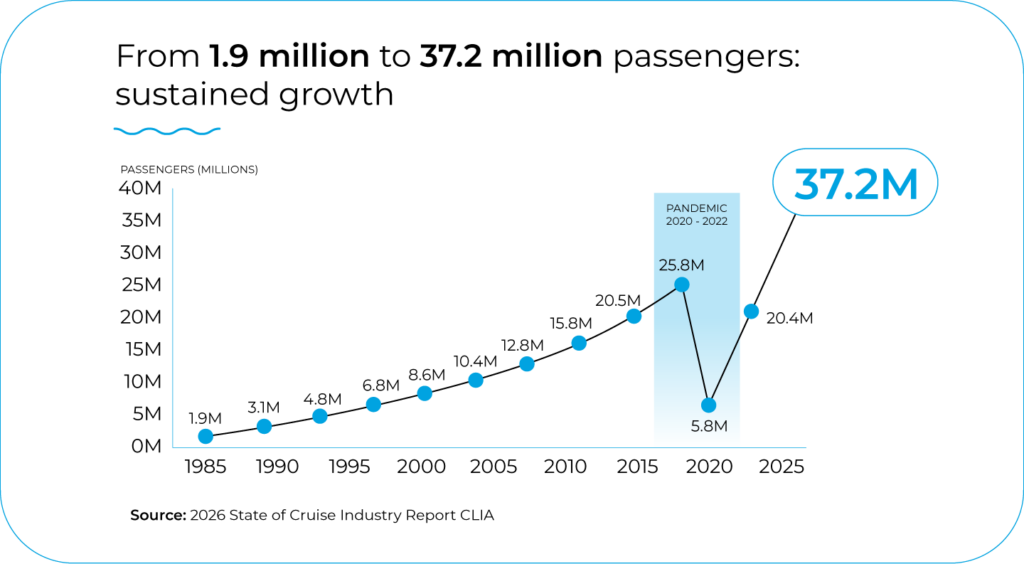
According to the latest CLIA reports (2025 Global Market Report and preliminary 2026 data), passenger volume has grown from 1.9 million in 1985 to 37.2 million in 2025, consolidating decades of sustained structural growth. The sector has fully recovered after the pandemic, positioning itself as one of the most resilient segments in tourism. Furthermore, nearly 90% of cruise passengers plan to sail again, reinforcing the recurring nature of the business.
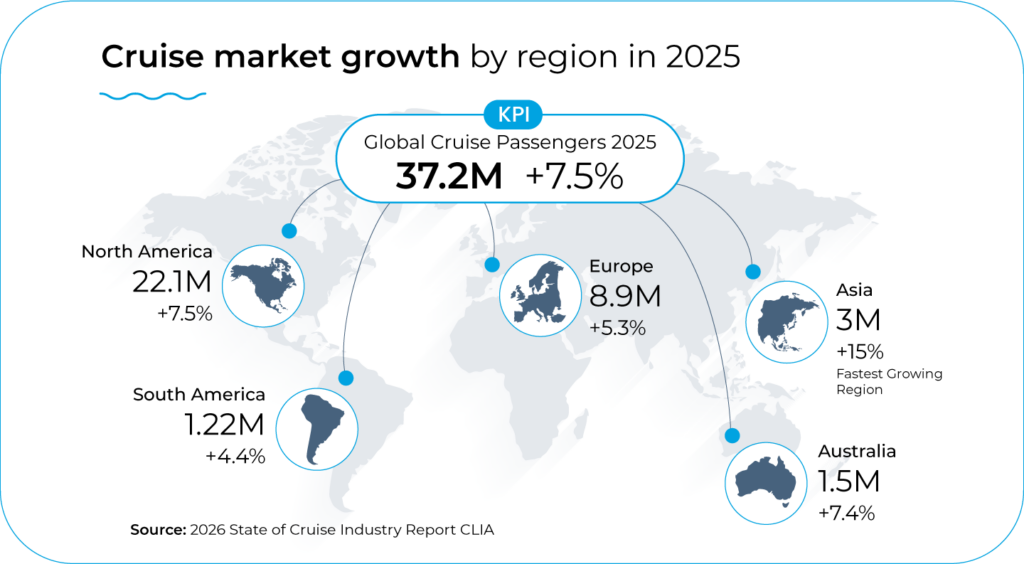
Demand continues to grow steadily and sustainably, even from higher baselines. Asia is emerging as the fastest-growing market (+15%), driving new opportunities for international distribution. In this context, selling cruises is no longer just about access to product, but about how it is managed, integrated, and scaled operationally.
The challenge: relying solely on cruise line systems. Many agencies and B2B operators work directly with the cruise lines’ own systems (Royal Caribbean, MSC, Costa, etc.). While these systems are necessary, they present clear limitations as the business scales.
The solution: a unified platform for cruise distribution
This is where the value of a solution like IST comes into play. Instead of working line by line, agencies can operate from a single platform or API that centralizes the entire ecosystem.
What does a unified approach deliver?
A unified approach allows agencies to access multiple cruise lines from a single environment, centralizing information and simplifying daily operations. By integrating content, availability, and pricing into one platform, fragmentation is eliminated and comparison and decision-making capabilities are enhanced. In addition, API connectivity enables integration with websites, CRMs, and other internal systems, while data standardization across providers ensures consistency and efficiency across all processes.
Overall, this transforms a fragmented operating model into a truly scalable, agile, and efficient system.
Key benefits for B2B agencies
Especially for mid-sized and large agencies, the impact is direct on business performance and profitability:
- Increased team productivity: Less time navigating between systems, faster quotation processes, reduced repetitive tasks
- Booking automation: Direct integration with reservation systems, less manual intervention, faster conversion
- Simplified sales processes: Structured and comparable information, better advisory tools, more agile sales experience
- Reduced operational workload: Fewer manual errors, less dependency on complex internal processes, more efficient teams
- Maintained agreements with cruise lines: Commissions and commercial conditions are preserved—this does not replace cruise lines, but optimizes distribution
Strategic key: growth in emerging markets like Asia
Asia’s +15% growth is not accidental, but reflects a structural shift in global cruise demand. For agencies, this creates major opportunities—but also new operational challenges: accessing increasingly diverse international supply, managing more providers, and adapting to different customer profiles with specific expectations and behaviors.
It also requires the ability to scale operations without proportionally increasing costs—something only possible through efficient, automated processes. Without the right technological layer to support this growth, expansion into these markets often results in increased complexity and reduced efficiency.
Conclusion: change is no longer optional
The cruise market is growing, globalizing, and becoming more competitive, forcing agencies to rethink how they operate. Those that continue to rely on isolated systems will face serious challenges in scaling and adapting to this new environment. In contrast, those that invest in technology will be able to reduce operational costs, increase sales capacity, adapt more quickly to international markets, and fully capitalize on industry growth.
In this context, competitive advantage is no longer about access to product, but about how it is managed and distributed.
This is where solutions like IST make the difference: providing the technological infrastructure needed to unify providers, automate processes, and scale cruise sales sustainably. For agencies looking to grow without increasing operational complexity, having a solution like FIBOS is not just a competitive advantage—it is a natural step toward a more efficient, future-ready distribution model.
On the other hand, solutions like ARGO enable agencies specialized in the cruise segment to quickly and efficiently launch their market offering through a white-label model. This significantly accelerates time to market, reduces development timelines, and enables agile implementation to capitalize on opportunities in this vertical.
Discover how cruise distribution works on a unified platform. We’ll show you how to centralize cruise lines, automate bookings, and optimize your daily operations. Book an IST demo.